1. Introduction
The heart receives oxygen-rich blood through a network of blood vessels called coronary arteries. When these arteries become narrowed or blocked due to plaque buildup, the heart may not receive enough blood, increasing the risk of chest pain, heart attack, and other cardiovascular complications.
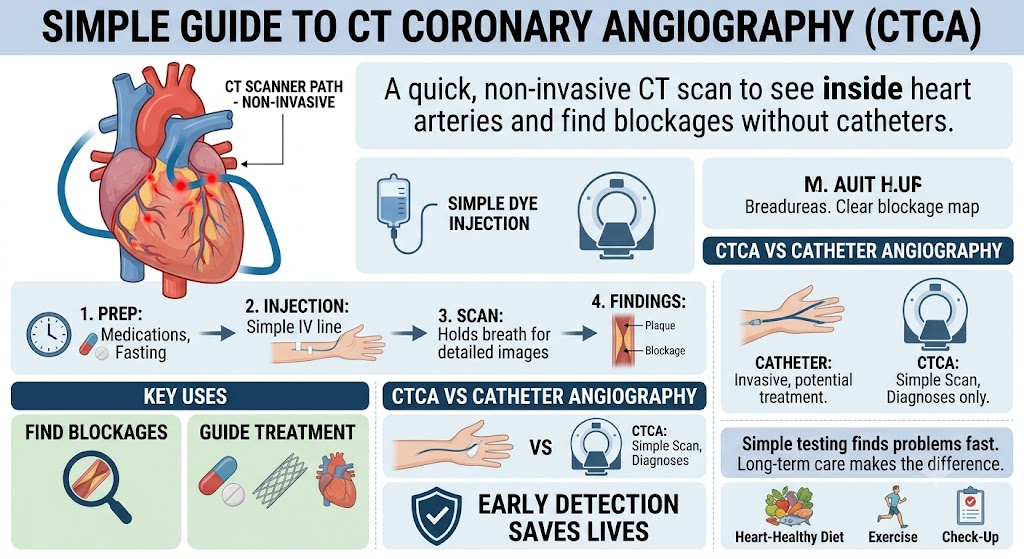
CT Coronary Angiography (CTCA) is an advanced, non-invasive imaging test that uses computed tomography (CT) technology and contrast dye to create detailed images of the coronary arteries.
It helps doctors identify blockages, plaque deposits, and abnormalities in the heart’s blood vessels without the need for traditional invasive catheter-based angiography.
Understanding what CT coronary angiography is, why it is performed, how it works, and what the results mean can help patients make informed decisions about their heart health.
2. What Is CT Coronary Angiography?
CT Coronary Angiography Definition
CT Coronary Angiography (CTCA) is a specialised CT scan that provides detailed images of the coronary arteries.
During the procedure, a contrast dye is injected into a vein, and a CT scanner captures images of the heart and blood vessels. Advanced computer technology combines these images to create a detailed view of the coronary arteries.
CT Coronary Angiography Can Show
- Narrowing of coronary arteries
- Blockages caused by plaque
- Calcium deposits in arteries
- Structure of coronary vessels
- Heart anatomy
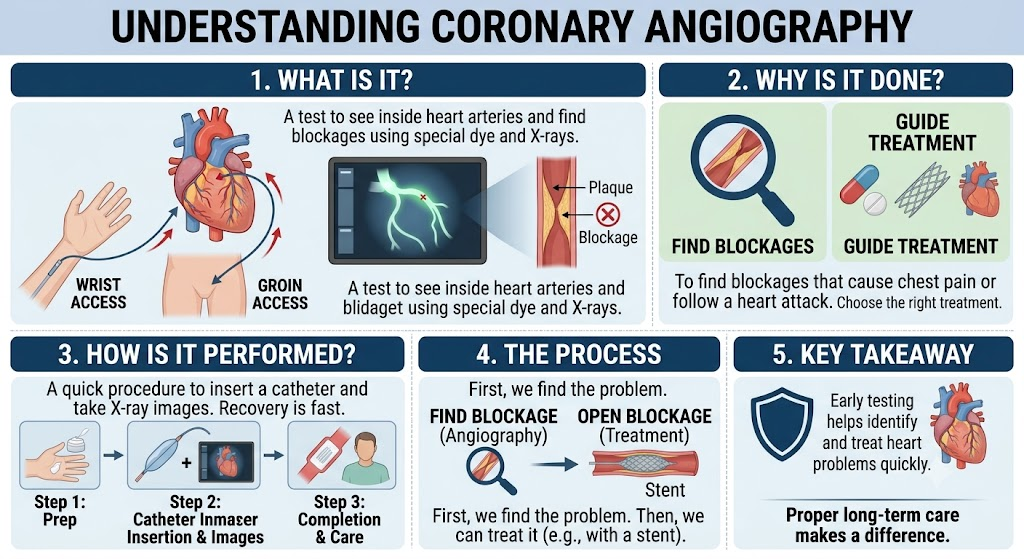
Unlike conventional coronary angiography, CTCA does not require inserting a catheter into the heart arteries.
3. Why Is CT Coronary Angiography Done?
Doctors may recommend CTCA for several reasons.
3.1 Detecting Coronary Artery Disease
CT coronary angiography is commonly used to identify:
- Narrowed coronary arteries
- Plaque buildup
- Early signs of coronary artery disease
It helps determine whether chest symptoms may be related to reduced blood flow to the heart.
3.2 Evaluating Chest Pain
CTCA may be recommended for patients with:
- New or unexplained chest discomfort
- Low to intermediate risk of coronary artery disease
- Uncertain results from other cardiac tests
3.3 Assessing Coronary Artery Blockages
The scan provides information about:
- Location of blockages
- Severity of narrowing
- Amount and type of plaque
3.4 Evaluating Heart Risk
CTCA can help identify early coronary artery changes in selected patients with cardiovascular risk factors.
Risk Factors Include
- High cholesterol
- Diabetes
- High blood pressure
- Smoking
- Family history of heart disease
3.5 Assessing Bypass Grafts and Coronary Anatomy
In selected cases, CT angiography may be used to evaluate:
- Previous bypass grafts
- Abnormal coronary artery anatomy
4. How Does CT Coronary Angiography Work?
CTCA uses a combination of:
- X-ray imaging
- Computer processing
- Contrast dye
The contrast dye highlights the coronary arteries, allowing the CT scanner to capture detailed images of blood flow and vessel structure.
A high-speed CT scanner takes multiple images while the heart is beating. Special software combines these images to create detailed views of the coronary arteries.
5. CT Coronary Angiography Procedure
5.1 Before the Test
Preparation may include:
- Avoiding food for a few hours before the scan if advised
- Informing the doctor about allergies, kidney problems, and medications
- Checking heart rate before the procedure
Some patients may receive medication to slow the heart rate temporarily, as clearer images are obtained when the heart beats steadily.
5.2 During the Test
The procedure usually involves:
Step 1: Patient Preparation
The patient lies on the CT scanner table.
Step 2: Heart Monitoring
ECG electrodes are attached to monitor heart rhythm.
Step 3: Contrast Injection
Contrast dye is injected through an intravenous line.
Step 4: Image Capture
The scanner captures images of the heart and coronary arteries.
Step 5: Breath Holding
The patient may be asked to hold their breath briefly during scanning.
The actual scanning time is usually only a few minutes.
5.3 After the Test
Most patients can return to normal activities after the scan.
Drinking adequate fluids may be advised to help remove the contrast dye from the body.
6. What Can CT Coronary Angiography Detect?
6.1 Coronary Artery Blockages
It can show areas where plaque has narrowed the arteries.
6.2 Coronary Plaque
The scan can detect different types of plaque:
- Calcified plaque
- Non-calcified plaque
- Mixed plaque
6.3 Coronary Artery Anomalies
Some people have variations in the structure or pathway of coronary arteries, which can be identified through CT imaging.
6.4 Bypass Graft Problems
CT angiography can assess whether bypass grafts remain open and functioning.
7. Benefits of CT Coronary Angiography
7.1 Non-Invasive Procedure
Unlike conventional angiography, CTCA does not require a catheter inserted into the coronary arteries.
7.2 Detailed Images
It provides high-resolution images of coronary arteries and plaque.
7.3 Early Detection
It can detect coronary artery disease before severe symptoms develop in appropriate patients.
7.4 Faster Procedure
The scan itself usually takes only a short time.
8. Limitations of CT Coronary Angiography
Although CTCA is highly useful, it may not be suitable for everyone.
Limitations Include
- Exposure to a small amount of radiation
- Use of contrast dye
- Reduced image quality with very high heart rates
- Difficulty interpreting heavily calcified arteries in some cases
Doctors consider the patient’s overall health before recommending the test.
9. Risks of CT Coronary Angiography
CTCA is generally safe, but possible risks include:
9.1 Contrast Dye Reaction
Some people may experience allergic reactions to the contrast material.
9.2 Kidney Function Concerns
Contrast dye may require caution in people with significant kidney disease.
9.3 Radiation Exposure
The scan involves a low level of radiation exposure. Modern scanners are designed to minimise radiation dose.
10. Difference Between CT Coronary Angiography and Conventional Angiography
CT Coronary Angiography (CTCA)Conventional Coronary AngiographyNon-invasive test | Invasive procedure
Uses CT scan and contrast dye | Uses catheter and X-ray
No tube is inserted into heart arteries | A catheter is inserted into heart arteries
Mainly used to detect blockages | Used to detect and treat blockages
Quick recovery | Requires more monitoring after procedure
Lower risk of complications | Higher risk due to catheter insertion
11. CT Coronary Angiography vs TMT
CT Coronary AngiographyTMTShows coronary artery structure | Evaluates heart response during exercise
Detects plaque and blockages | Detects exercise-related changes
Uses CT imaging | Uses treadmill exercise and ECG monitoring
Doctors may choose one test over another depending on symptoms and risk profile.
12. Who May Need CT Coronary Angiography?
Doctors may recommend CTCA for people with:
- Unexplained chest pain
- Intermediate risk of coronary artery disease
- Abnormal or unclear stress test results
- Family history of premature heart disease
- Multiple cardiac risk factors
13. How to Prepare for CT Coronary Angiography
Before the test:
- Inform your doctor about kidney disease or allergies
- Discuss current medications
- Avoid caffeine if advised
- Follow fasting instructions if provided
- Wear comfortable clothing
14. Frequently Asked Questions About CT Coronary Angiography
14.1 Is CT Coronary Angiography Painful?
No. The scan itself is painless. Some people may feel a brief warm sensation when contrast dye is injected.
14.2 How Long Does CT Coronary Angiography Take?
The scan is usually completed within a few minutes, although preparation may take longer.
14.3 Can CT Coronary Angiography Detect Heart Blockage?
Yes. CTCA can detect narrowing and plaque buildup in coronary arteries.
14.4 Is CTCA Better Than Angiography?
Both tests have different purposes. CTCA is a non-invasive diagnostic test, while conventional angiography can diagnose and treat certain blockages during the same procedure.
14.5 Is CT Coronary Angiography Safe?
For most suitable patients, CTCA is considered safe. Doctors evaluate kidney function, allergies, and other factors before performing the test.
15. Conclusion
CT Coronary Angiography is an advanced, non-invasive cardiac imaging test that provides detailed information about the coronary arteries. It plays an important role in detecting plaque buildup, evaluating chest pain, and assessing the risk of coronary artery disease.
Early identification of coronary artery problems allows doctors to recommend appropriate lifestyle changes, medicines, or further treatments when required.
Maintaining healthy cholesterol levels, controlling blood pressure and diabetes, exercising regularly, and undergoing recommended cardiac evaluations are essential for long-term heart health.